

Aluminium fabrication (aluminium fabrication kuwait — اعمال الكوبوند الكويت) sits at the heart of the commercial construction, signage, retail fit-out, and exhibition industries in Kuwait. From the ACP cladding on a commercial building facade to the precision-cut aluminium letters on a luxury retail signage sign, from the structural frame of an exhibition kiosk (بوثات للمعارض الكويت) to the carpentry-integrated shopfitting of a high-end restaurant — quality aluminium fabrication underpins the visual environment of Kuwait’s commercial landscape.
Choosing the right aluminium fabrication company for your commercial project is consequently one of the most consequential decisions in any fit-out, signage, or construction brief. Get it right and your project is delivered on time, on budget, and to the standard your brand demands. Get it wrong and you face delays, rework, quality failures, and the reputational damage that comes from a commercial space that doesn’t reflect your brand standards.
This guide covers exactly what to evaluate when choosing an aluminium fabrication partner for commercial projects in Kuwait.
Understand What Your Project Actually Requires
Before approaching any aluminium fabrication company, it is essential to be clear about what your project actually involves. Aluminium fabrication (قص جميع المعادن الكويت) covers an enormous range of applications, and different companies specialise in different areas. Matching the fabricator’s core competency to your project’s primary requirements is the first and most important step.
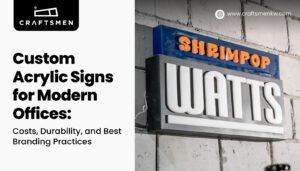
Signage and lettering: If your project is primarily signage-focused — 3D letter signage (3d letter Signage kuwait), fascia panels, LED signage (LED Signage kuwait) housings, or ACP panel sign structures — you need a company with specific experience in signage-grade aluminium fabrication: precision cutting, tight tolerances on letter profiles, surface finishing capability, and experience integrating LED systems into fabricated structures.
Retail fit-out and shopfitting: If your project involves aluminium shopfront systems, display structures, shelving, ceiling grids, or partition systems for a retail environment, you need a company experienced in architectural aluminium systems — profile selection, joinery detailing, and coordination with other trades such as carpentry (اعمال خشبية الكويت — Carpentry kuwait) and glass.
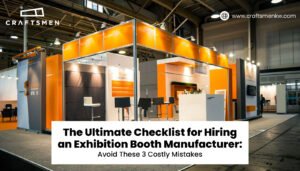
Exhibition kiosks and booths: Booth manufacturing (Booth manufacturing kuwait) and exhibition kiosk fabrication requires a company with experience in designing demountable or semi-permanent structures that balance visual impact with structural integrity, portability, and the ability to be assembled and disassembled repeatedly.
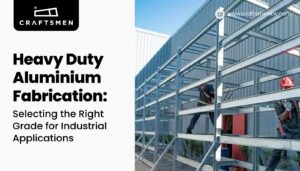
Structural and architectural: For larger-scale aluminium fabrication — curtain walling, louvre systems, pergolas, canopies, and structural cladding systems — you need a company with engineering capability, structural calculation experience, and familiarity with Kuwait’s building regulations and municipality approval processes.
Knowing which category your project falls into — or which combination of categories — allows you to filter candidates meaningfully before investing time in detailed conversations.
Evaluate Portfolio and Relevant Experience
No single piece of evidence about an aluminium fabrication company’s capability is more reliable than their portfolio of completed work. Ask for case studies, photographs, and — ideally — references from clients on projects similar to yours in scale, application, and specification.
When reviewing a portfolio, look specifically for:
Finish quality: Does the surface finishing on fabricated aluminium elements look precise and consistent? Are corners, joints, and edges clean and tight? Poor finishing quality is one of the most visible indicators of substandard fabrication, and it is very difficult to correct after installation.
Complexity handled: Has the company fabricated complex curved profiles, unusual shapes, or bespoke design elements? A company that has handled complex fabrication challenges successfully is more likely to handle your project’s specific requirements — whatever they are — than one whose portfolio shows only simple rectangular panels.
Scale matched to your project: A company that typically handles small signage orders may not have the infrastructure — machinery, workshop space, workforce — to handle a large retail fit-out on the timescale you need. Equally, a company set up for large structural projects may not have the precision finishing capability required for high-quality 3D letter signage. The scale of their typical projects should be broadly comparable to yours.
Integration with other trades: Many commercial aluminium fabrication projects require integration with steel fabrication (استيل الكويت — Steel fabrication kuwait), carpentry (اعمال خشبية الكويت), acrylic (اكليرك الكويت), printing (طباعة الكويت — Printing Kuwait), and electrical work for LED systems. A fabricator who regularly manages multi-trade projects is a more reliable partner than one who works exclusively in isolation.
Assess Workshop Capability and Machinery
The quality of the output is directly dependent on the quality of the equipment and workspace producing it. A site visit to the fabrication workshop — if at all possible — is one of the most revealing ways to evaluate a potential partner.
In a well-equipped aluminium fabrication workshop in Kuwait, you would expect to see:
CNC cutting and routing equipment (قص جميع المعادن الكويت): Precision computer-controlled cutting is essential for accurate letter profiles, panel cutouts, and complex shapes. Hand-cut fabrication introduces human error that is visible in the finished product. Verify that the company uses CNC equipment and that it is well-maintained.
Bending and rolling equipment: For aluminium profiles that need to be formed into curves, channels, or box sections, the company needs appropriate bending and rolling machinery. The quality of bends and formed sections is visible in the finished product.
Welding capability: MIG and TIG welding for aluminium requires different equipment and skills than steel welding. Not all metal fabricators are equally capable with aluminium welding. Look for evidence of clean, consistent welds in portfolio examples.
Surface treatment and finishing: Powder coating, anodising, and polishing all require either in-house equipment or reliable sub-contractor relationships. Ask the company where surface treatment is carried out, what quality control they apply to incoming treated materials, and what warranty they offer on the finish.
Workshop organisation and cleanliness: The condition of the workshop reflects the company’s operational discipline. A well-organised, clean workshop suggests careful materials handling, quality consciousness, and professional management. A chaotic, poorly maintained workshop raises questions about consistency.
Verify Technical Capability for Your Specific Application
Different aluminium fabrication applications require different technical knowledge, and it is worth specifically probing the company’s technical capability for your particular requirements.
For 3D letter signage and fascia systems: Ask how they handle the return (the side depth of a 3D letter), how they attach letters to the substrate, how they manage the waterproofing of external letter installations, and how they integrate LED systems. These technical details determine whether the finished installation looks as good in two years as it did on installation day — which in Kuwait’s climate and building environment is a genuine concern.
For ACP (aluminium composite panel) works: Ask about the thickness and brand of ACP they use, how they handle panel joints and reveals, what sealant systems they use for external ACP installations, and whether their installation teams are trained in proprietary ACP fixing systems. Substandard ACP installation is a common source of premature failure — panels lifting, joints opening, water ingress — in Kuwait’s commercial buildings.
For exhibition kiosks and booth structures: Ask about the structural engineering behind their kiosk designs, how they manage repeated assembly and disassembly cycles, what surface materials they use and how they hold up through multiple events, and whether they can provide fabrication drawings that can be approved by event organisers before build.
For steel fabrication components: Many aluminium fabrication projects include steel components — particularly structural elements that carry loads beyond aluminium’s practical range. A fabrication company that can handle both steel fabrication Kuwait and aluminium within the same workflow — or that has an established, quality-controlled relationship with a steel subcontractor — simplifies project management significantly.
Evaluate Design and Drawing Capability
The best aluminium fabrication companies in Kuwait are not simply manufacturers — they are also design and engineering partners. A company that can contribute technically to your project’s design development — suggesting material choices, advising on fabrication-friendly design adjustments, identifying potential installation challenges before they become site problems — adds significant value beyond the fabrication itself.
Ask any potential fabrication partner:
Do you produce full fabrication drawings (shop drawings) before commencing production? Can you provide drawings in CAD format for coordination with other project disciplines? Do you have in-house design capability, or do you rely entirely on client-provided drawings? Have you worked on projects requiring municipality or client approval of fabrication drawings?
A company that produces thorough shop drawings before any cutting or welding begins is protecting both itself and its client from the most common and expensive sources of error in commercial fabrication projects: misunderstood dimensions, details that can’t be fabricated as drawn, and conflicts between the fabricated elements and the building conditions they’re being installed into.
Consider the Full Service — Fabrication, Supply, and Installation
Aluminium fabrication in isolation — supply-only — is only part of what most commercial projects need. Installation is where many fabrication projects succeed or fail, because a beautifully fabricated component that is poorly installed looks bad, performs badly, and reflects poorly on everyone involved.
A fabrication company that also has experienced, trained installation teams has a significant structural advantage over one that fabricates and then hands over to a third-party installer: they know how their fabricated elements are supposed to go together, they can problem-solve on site from a position of technical authority, and they are accountable for the whole outcome rather than just the component.
When evaluating installation capability, ask about the company’s installation team composition — how many installers, what their experience level is, whether they are permanent employees or subcontracted — and ask for references specifically for installation quality rather than just fabrication quality.
Also ask about after-installation support: what happens if a component fails, is damaged, or needs adjustment after installation? A company that stands behind their installed work with a warranty and a responsive after-service is a far more reliable long-term partner than one whose accountability ends when the installation crew packs up.
Understand Timelines and Project Management Capability
For commercial projects — retail fit-outs, restaurant launches, exhibition kiosk preparations — the timeline is often as critical as the quality. A delayed signage installation can push back a shop opening; a late exhibition kiosk can miss the entire event. Understanding a fabrication company’s actual lead times, production capacity, and project management capability before you commit is essential.
Ask directly:
What is your current production capacity and lead time for a project of this scale? Do you have dedicated project managers for commercial contracts? How do you handle timeline conflicts if your workshop is busy? What is your process for communicating progress and flagging delays?
A company that gives you a confident, specific answer to these questions with evidence from their project management process is more reliable than one that gives you optimistic general assurances without a credible process behind them.
Assess Value, Not Just Price
In Kuwait’s commercial fabrication market, pricing varies significantly between providers — and the cheapest option is rarely the best value. Substandard aluminium gauge (thinner than specified), poor-quality surface treatment, imprecise cutting, or inadequate installation can result in a finished product that looks poor from day one, deteriorates rapidly in Kuwait’s climate, and costs significantly more to remediate than the original saving was worth.
When comparing quotations, ensure you are comparing equivalent specifications: the same aluminium gauge, the same surface treatment method and warranty, the same installation scope, and the same post-installation support terms. A meaningful price comparison is only possible when the specification is genuinely equivalent across quotations.
At Craftsmen Kuwait, our aluminium fabrication Kuwait capability covers signage, 3D letter signage, LED signage housings, ACP works, steel fabrication, exhibition kiosks and booth manufacturing, carpentry integration, and full installation — handled as a complete service from design through fabrication to installation and after-care. Contact our team to discuss your commercial project requirements.