

The signage industry has always been shaped by its tools. Screen printing gave signage colour at scale. CNC routing gave it dimensional precision. Digital printing gave it photographic quality. And now fiber laser technology is changing what’s possible in metal signage — not incrementally, but fundamentally.
For signage brands in Kuwait working with stainless steel, aluminium, brass, and other metals, fiber laser cutting and engraving isn’t just an upgrade from older methods. It’s a different category of capability that opens applications, improves quality, and changes the economics of metal signage production in ways that matter commercially.
What Is Fiber Laser Technology?
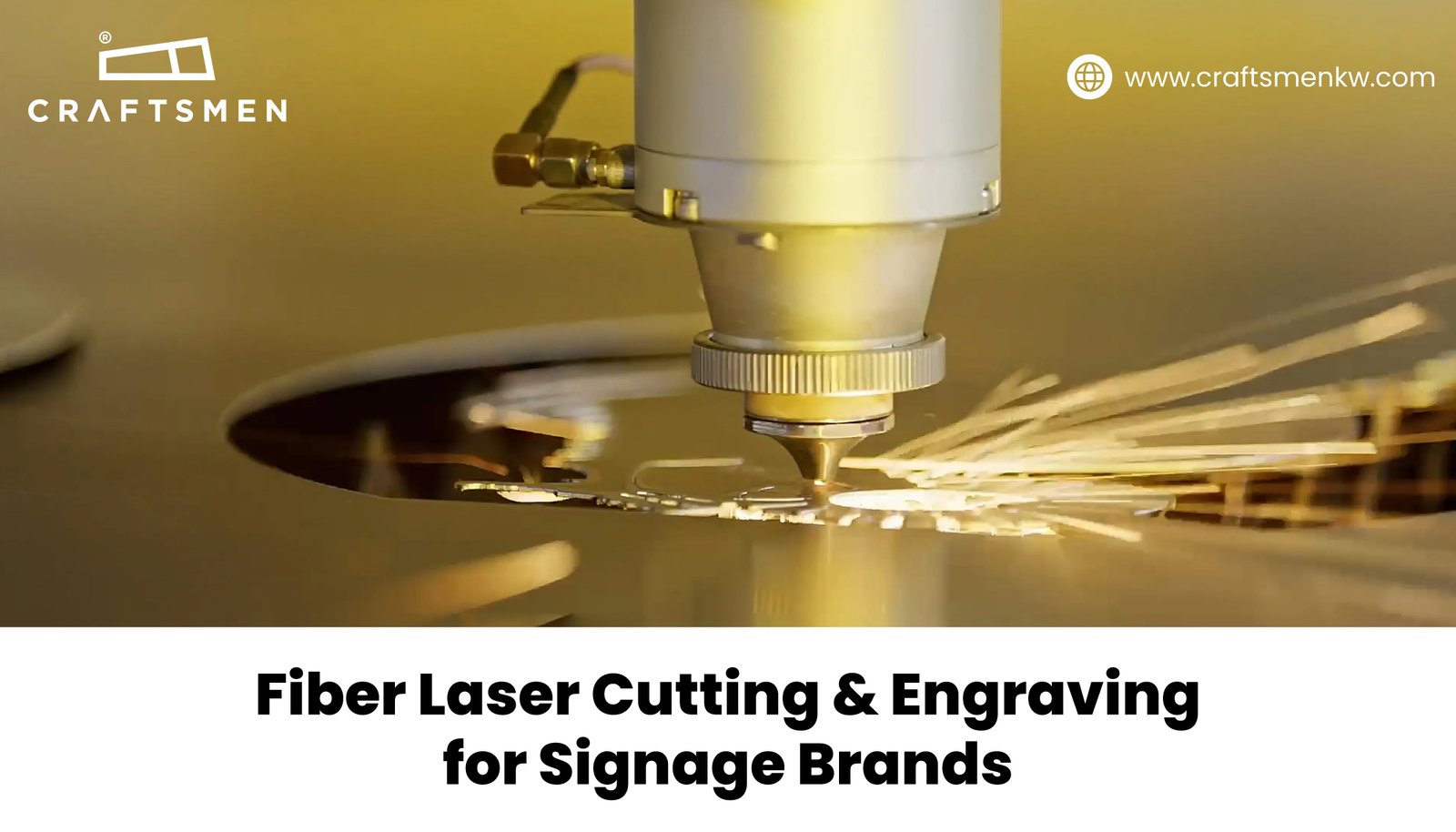
A fiber laser is a type of industrial laser where the laser beam is generated within an optical fibre doped with rare-earth elements — typically ytterbium. The laser beam produced is extremely intense, tightly focused, and operates at a wavelength (around 1,064 nanometres) that is particularly well-absorbed by metals.
This absorption efficiency is what makes fiber lasers so effective on metal. CO₂ lasers — the older standard for laser cutting — are excellent on non-metals (acrylic, wood, leather, fabric) but are largely reflected by metal surfaces and struggle to cut metal effectively except at very high power levels. Fiber lasers interact with metal at the physical level in a fundamentally different and more efficient way, producing cleaner cuts, faster processing speeds, and far lower energy consumption per metre of cut.
For a signage business working primarily with metal, this distinction matters: a fiber laser is the right tool for the job in a way that CO₂ simply isn’t.
What Fiber Laser Cutting Delivers for Signage
Precision that older methods can’t match: A fiber laser beam can be focused to a spot size of fractions of a millimetre. This means letters, logos, and intricate design elements can be cut from metal with a precision that no mechanical cutting method — plasma cutting, water jet at standard tolerances, jig saw, or die cutting — can replicate. Arabic calligraphy in fine Naskh script, at small sizes, with all the connection points and diacritical marks intact: a fiber laser handles it. A router does not.
Clean, finished edges without secondary processing: Plasma cutting and mechanical cutting leave edges that require grinding, deburring, and finishing before a signage piece is presentable. A well-set fiber laser produces edges that are clean, slightly polished by the cutting process, and ready for finishing without secondary grinding. This saves significant production time on high-volume signage work.
Speed: Fiber lasers cut metal at speeds that were unimaginable with earlier technologies. A modern fiber laser cutting system can process stainless steel sheet significantly faster than plasma, water jet, or routing — directly affecting the economics of metal signage production. Faster cutting means more pieces per shift, lower per-unit cost, and shorter lead times for clients.
Narrow kerf width: The kerf — the width of material removed by the cutting process — of a fiber laser is very narrow, often less than 0.2mm on thin sheet. This allows closely nested design elements in a sheet layout, minimising material waste. On expensive materials like stainless steel and brass, this matters financially.
Consistency: A fiber laser cutting system produces identical cuts on every piece, every time, without the variability introduced by tool wear in mechanical cutting or electrode degradation in plasma. For signage brands producing sets of dimensional letters that must be identical — a building’s worth of door numbers, a multi-floor wayfinding system — this consistency is critical.
Fiber Laser Engraving: A Different Application
Cutting through material is one application. Engraving — removing or altering the surface without cutting through — is another, and for signage it’s equally important.
Fiber laser engraving on metal produces marks by one of several mechanisms depending on settings:
Surface ablation: The laser removes the surface layer of material, exposing the substrate below. On painted or coated metals, this reveals the base metal. On anodised aluminium, it removes the anodised layer. Used for engraving text, logos, and graphics on coated or coloured metal panels.
Annealing: On stainless steel particularly, certain fiber laser settings cause an oxidation reaction at the surface that produces a colour change — ranging from gold to blue to black — without removing material. The surface is chemically altered but physically unchanged — no texture, no depth, just a colour mark. This produces extremely fine, precise marks that are flush with the surface and highly durable. Used for product identification, serial numbers, compliance marking, and decorative engraving on premium stainless steel signs.
Deep engraving: Multiple passes at high power remove material progressively, creating genuine depth in the surface. Used for plaques, commemorative signage, and feature elements where tactile depth adds to the premium perception of the piece.
Marking on dark materials: Fiber lasers can produce high-contrast white marks on dark anodised aluminium and other dark metals by disrupting the surface at a microscopic level — creating a matte, light-scattering surface against a specular background. Used for technical nameplates, equipment identification, and precision marking applications.
For signage brands, the engraving applications most relevant commercially include:
- Etched logos and text on metal plaques and nameplates
- Company name and branding on reception feature panels
- Room numbers and door identification on metal plates for hotels and office buildings
- Serial numbers, safety information, and compliance marking on equipment and industrial signage
- Decorative patterns and textures on feature wall panels
- QR codes on metal signage — fiber laser-engraved QR codes are far more durable than printed or stickered alternatives
Metal Compatibility: What Fiber Lasers Work On
This is one of the most commercially significant aspects of fiber laser technology for signage brands. A fiber laser works effectively on:
Stainless steel — the primary material for premium signage in Kuwait. Fiber laser cutting produces exceptional edge quality on stainless steel from 0.5mm thin sheet up to 20mm+ thick plate, depending on machine power. Engraving produces sharp, precise marks.
Mild steel — used for structural signage components, brackets, and frameworks. Cuts faster than stainless with equivalent results.
Aluminium — widely used in signage for its light weight and corrosion resistance. Fiber lasers cut aluminium well, though it requires more power per mm of thickness than steel due to aluminium’s high thermal conductivity.
Brass and copper — traditional premium signage metals. Historically difficult to cut cleanly with plasma or mechanical methods. Fiber lasers handle both well, though operator experience matters for optimising settings.
Galvanised steel — note that cutting galvanised steel produces zinc oxide fumes that require proper extraction. This is a health and safety consideration that must be addressed in any facility.
How Fiber Laser Technology Changes the Economics of Metal Signage
For a signage business in Kuwait, the economics of fiber laser technology affect both production cost and commercial positioning.
On the production side, the combination of speed, precision, and reduced secondary finishing work lowers the per-unit cost of metal signage components compared to older cutting methods. This doesn’t necessarily mean lower prices — it means better margins, or the ability to invest in quality at the same price point, or both.
On the commercial positioning side, fiber laser capability changes what you can offer clients. Intricate laser-cut screens and panels for architectural applications — perforated stainless steel feature walls, decorative metal room dividers, backlit laser-cut fascia panels — are only economically viable with fiber laser technology. These are high-value applications that command premium pricing and differentiate a signage business from competitors still working with older methods.
For custom one-off and short-run work — a single custom nameplate, a set of personalised awards, a bespoke entrance sign — fiber laser’s lack of tooling costs makes it uniquely cost-effective. There’s no setup for a laser job beyond the digital file. No die to cut, no screen to expose, no jig to build. This makes fiber laser ideal for the premium custom work that generates strong margins.
What to Look for in Fiber Laser Equipment
Not all fiber laser systems are equivalent. For signage applications, the key specifications to consider:
Power: Measured in watts. Higher power cuts faster and handles thicker material. For signage work primarily in 1mm to 6mm sheet metal, a 1500W to 3000W system is sufficient. For cutting thicker structural components, higher power is needed. For engraving only, lower power systems are adequate.
Cutting area: The bed size determines the maximum sheet size you can process. Standard sheet metal sizes in Kuwait are typically 1m x 2m or 1.25m x 2.5m. A cutting system that accommodates full sheets eliminates the need to cut sheets down before processing — a significant time saving.
Positioning accuracy: For signage applications where precision matters, look for systems with positioning accuracy of ±0.03mm or better and repeatability of ±0.02mm or better.
Software: The CAD/CAM software that drives the laser system determines how efficiently you can go from digital design file to cut parts. Compatibility with the design file formats used by your design team — typically DXF, DWG, or AI — is essential. Nesting software that automatically optimises part placement on sheets to minimise waste saves material cost on every job.
Cooling system: Fiber lasers generate heat during operation and require cooling — typically a water chiller. In Kuwait’s climate, the ambient temperature affects chiller performance, and the system must be sized appropriately for year-round operation at Gulf temperatures.
Integration With a Signage Workflow
For signage brands adding fiber laser capability, integration with the existing workflow is as important as the machine specification.
The design-to-cut process for laser work starts with a vector file — typically DXF or DWG for cutting paths. If your design team works in Illustrator or CorelDraw, the workflow from design to cut file is straightforward. If they work in Photoshop or other raster-based tools, a vector conversion step is needed.
Quality control after cutting is important — particularly for fine detail work in Arabic text where a missed cut or incomplete detail on a single letter affects the whole sign. Building a checking step into the workflow before pieces move to finishing and installation prevents expensive rework.
For finishing after cutting — brushing, polishing, painting, or PVD coating — fiber-laser-cut pieces generally present cleanly and respond well to standard metal finishing processes.
The Competitive Advantage of Fiber Laser Capability in Kuwait
Kuwait’s premium commercial signage market — hotels, malls, corporate towers, government and institutional buildings — demands quality that older fabrication methods struggle to deliver consistently. Fiber laser capability positions a signage brand to compete for and win this work.
The ability to cut intricate Arabic calligraphy precisely, produce perforated decorative panels, engrave fine detail on plaques and nameplates, and do all of this with the speed and consistency that modern project timelines demand: this is what fiber laser technology provides. It is not a marginal improvement. It is a fundamentally different level of capability that reshapes what a signage business can offer and how it competes.
For signage brands in Kuwait that are serious about the premium segment of the market, fiber laser technology is not optional equipment. It’s the foundation of a modern metal signage operation.