

Walk into any premium hotel lobby, corporate headquarters, or upscale retail outlet in Kuwait and you’ll notice the same thing: the signage isn’t plastic. It isn’t painted aluminium. It’s metal — specifically, stainless steel — and it communicates something before a single word is read. It says permanence. It says quality. It says this business is serious.
Stainless steel has become the material of choice for businesses that understand the relationship between their physical environment and their brand perception. But the choice isn’t purely aesthetic. There are functional, financial, and practical reasons why stainless steel signage outperforms alternatives — and why once businesses switch, they rarely go back.
What Makes Stainless Steel Different From Other Signage Materials
The signage market offers no shortage of options: acrylic, aluminium composite, PVC, wood, glass, and more. Each has its place. But stainless steel occupies a category of its own — not because it’s the cheapest or easiest to work with, but because it delivers a combination of properties no other single material can match.
The steel used in commercial signage is almost always 304 or 316 grade stainless steel. Grade 304 is the standard — it’s the most widely used, offers excellent corrosion resistance in most environments, and machines well. Grade 316 adds molybdenum to the alloy, making it significantly more resistant to chloride corrosion — which matters enormously in coastal environments like Kuwait, where salt air from the Arabian Gulf accelerates the degradation of standard metals.
Both grades share the defining characteristic of stainless steel: the chromium content, typically 10.5% or higher, reacts with oxygen to form a passive layer of chromium oxide on the surface. This layer is self-repairing — if the surface is scratched, the passive layer reforms in the presence of oxygen. This is what gives stainless steel its legendary corrosion resistance.
Durability in the Gulf Climate
Kuwait’s climate is one of the most demanding on the planet for exterior materials. Summer temperatures regularly exceed 50°C. The combination of intense UV radiation, desert dust, and coastal humidity creates conditions that destroy lesser signage materials within a few years.
Painted aluminium fades. PVC warps and yellows. Printed vinyl peels. Acrylic becomes brittle and cracks.
Stainless steel does none of these things. It doesn’t rust in normal outdoor conditions. It doesn’t fade because its finish isn’t a coating — it’s the surface of the metal itself. It doesn’t warp under heat. And it doesn’t become brittle under UV exposure the way polymer-based materials do.
For businesses investing in exterior building signage, entrance feature walls, directional signage systems, or outdoor wayfinding, the durability difference between stainless steel and alternatives is measured not in months but in decades.
A stainless steel sign installed correctly in Kuwait can last 20 to 30 years with minimal maintenance. The equivalent in painted aluminium might need refurbishment in five. In PVC, three.
When you calculate the total cost of ownership rather than just the installation cost, stainless steel consistently wins.
The Aesthetic Versatility of Stainless Steel
One of the persistent misconceptions about stainless steel signage is that it only looks one way — cold, industrial, brushed silver. The reality is considerably more versatile.
Modern finishing techniques give stainless steel signage a wide range of visual characters:
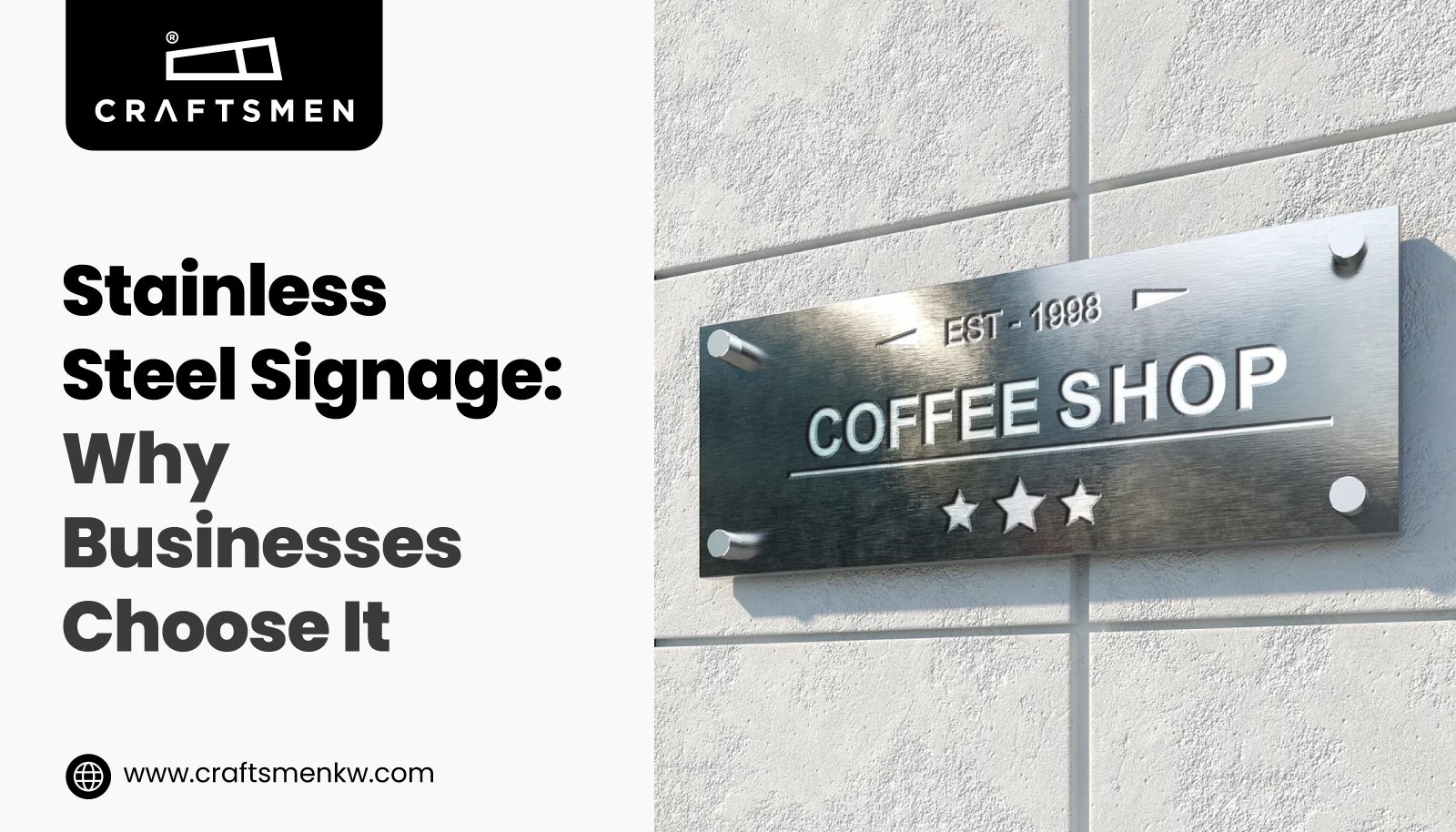
Brushed (satin) finish is the most common for signage. The directional grain gives the surface a sophisticated, matte-like appearance that reduces glare and fingerprints. It reads as premium and precise — ideal for corporate, financial, legal, and hospitality environments.
Mirror polish reflects its surroundings and creates a bold, dramatic effect. Used on statement lettering in hotel lobbies, luxury retail fascias, and high-end residential developments. Requires more maintenance to keep fingerprint-free but is visually striking.
Bead blast finish creates a uniform, matte texture across the surface. Subtle and refined — works well in healthcare, education, and contemporary architecture where the signage needs to integrate rather than dominate.
PVD (Physical Vapour Deposition) coating allows stainless steel to take on colours — gold, bronze, black, rose gold, champagne — without sacrificing the material’s durability. PVD coatings are deposited at the molecular level and are extraordinarily resistant to scratching and fading. This is how luxury brands achieve gold-toned metal signage that retains its colour indefinitely. Black stainless steel through PVD has become particularly popular in Kuwait’s premium commercial sector over the past few years.
Laser cutting and etching allows any level of detail to be rendered in stainless steel — from intricate Arabic calligraphy to fine-line logotypes to complex patterns. A laser cutter doesn’t touch the material mechanically, so there’s no distortion — just a clean, precise cut or etch that can render detail impossible to achieve with traditional fabrication methods.
Types of Stainless Steel Signage and Their Applications
Dimensional lettering and logos: Individual letters or logo elements cut from stainless steel sheet and either flush-mounted to a wall surface or standoff-mounted to create shadow depth. One of the most common applications in Kuwait’s commercial sector — used across banking, retail, hospitality, and corporate headquarters. Standoff-mounted letters with LED backlighting create a halo effect after dark that dramatically elevates a building’s street presence.
Feature walls and reception panels: Large format stainless steel panels, often etched or perforated with a company’s name, pattern, or branding, used as reception backdrops or entrance feature walls. Common in hotel lobbies, bank branches, and corporate offices.
Wayfinding and directional systems: Stainless steel frames with printed, etched, or applied inserts for directories, floor indicators, and directional arrows. The steel framework gives longevity while allowing individual inserts to be updated as tenant or floor occupancy changes.
Exterior fascia and building identification: Large-format stainless steel lettering on building exteriors — often combined with LED lighting for nighttime visibility. Requires engineering for wind load and thermal expansion in Kuwait’s extreme temperature range.
Plaques and commemorative signage: Awards plaques, founding date plaques, dedicatory signage, and regulatory compliance signs. Stainless steel is the default material for any application where permanence and authority are required.
Menu boards and retail display signage: PVD-coated stainless in hospitality environments — menus, pricing displays, and product identification in premium food and beverage outlets.
Why Stainless Steel Works Particularly Well in Kuwait
Beyond the climate arguments, there are specific reasons why the Kuwait and broader Gulf market has adopted stainless steel signage at a higher rate than many other markets.
The premium commercial construction market in Kuwait — hotels, malls, corporate towers, government buildings, and high-end residential developments — specifies to international quality standards. Architects and interior designers working on these projects are familiar with stainless steel’s properties and routinely specify it in signage packages precisely because it meets those standards reliably.
The Arabic calligraphy dimension is also significant. Kuwait’s signage market requires high-quality Arabic lettering on virtually every commercial sign. The precision of laser cutting means Arabic text — including the complex curves and connection points of Naskh and Kufi scripts — can be rendered in stainless steel with the accuracy and elegance that the script demands. Mechanical cutting methods struggle with Arabic text at small scales. Laser cutting does not.
There’s also a maintenance consideration specific to Kuwait’s environment. Desert dust settles on every outdoor surface. Stainless steel is easy to clean — a damp cloth removes surface dust and most marks. Coated surfaces, by contrast, can be damaged by repeated cleaning. Over the lifetime of a sign in Kuwait’s dusty environment, this matters.
Comparing Stainless Steel Against Common Alternatives
Aluminium composite (ACP): Lighter and cheaper than stainless steel, and widely used for flat sign faces and fascia panels. But ACP scratches easily, and the painted finish fades in intense UV. It doesn’t carry the same material authority that stainless steel does — a well-lit ACP sign and a well-lit stainless steel sign communicate very different things about the business behind them.
Acrylic: Used extensively for illuminated signage because it transmits light well. But acrylic cracks, scratches, and yellows over time — particularly in heat. Not appropriate for premium applications or permanent exterior installation.
Brass and bronze: Traditional premium metals for signage. Develop a patina over time that some find appealing, others don’t. Require polishing and maintenance to retain their appearance. Stainless steel, by contrast, is low maintenance by design.
PVC: Cheap and easy to fabricate. Has no place in premium commercial signage environments. Warps in heat, discolours under UV, and communicates cheap rather than considered.
Working With a Signage Specialist for Stainless Steel
Stainless steel signage requires expertise that not every signage company possesses. The material is harder to work with than aluminium or acrylic — it requires appropriate cutting equipment (laser cutting is standard for quality work), the right welding techniques for any three-dimensional fabrication, and finishing skills that preserve the surface quality throughout the fabrication process.
Choosing a supplier who understands the specific grades of stainless steel and their appropriate applications, who works with proper laser cutting equipment, and who has experience finishing and installing stainless steel in Gulf conditions is the difference between signage that performs as expected and signage that disappoints.
The installation detail also matters. Stainless steel expands and contracts with temperature changes. In Kuwait’s extreme temperature range — from perhaps 10°C in winter to 50°C+ in summer — the fixing system needs to accommodate thermal movement. An experienced signage fabricator engineers this into the installation method.
The Business Case in Summary
Stainless steel signage costs more upfront than most alternatives. That’s the single honest argument against it. Everything else — durability, climate performance, aesthetic versatility, low maintenance, brand authority — argues for it.
For businesses in Kuwait’s premium commercial, hospitality, retail, and corporate sectors, the calculation is straightforward. A stainless steel sign correctly specified and installed will outlast the business’s lease and likely the next one. It will not fade, warp, crack, or corrode under normal Gulf conditions. It will continue to communicate quality accurately for decades.
The businesses that choose stainless steel aren’t just buying a sign. They’re making a statement about the permanence of what they’re building — and investing in a material that will hold that statement for as long as they need it to.