


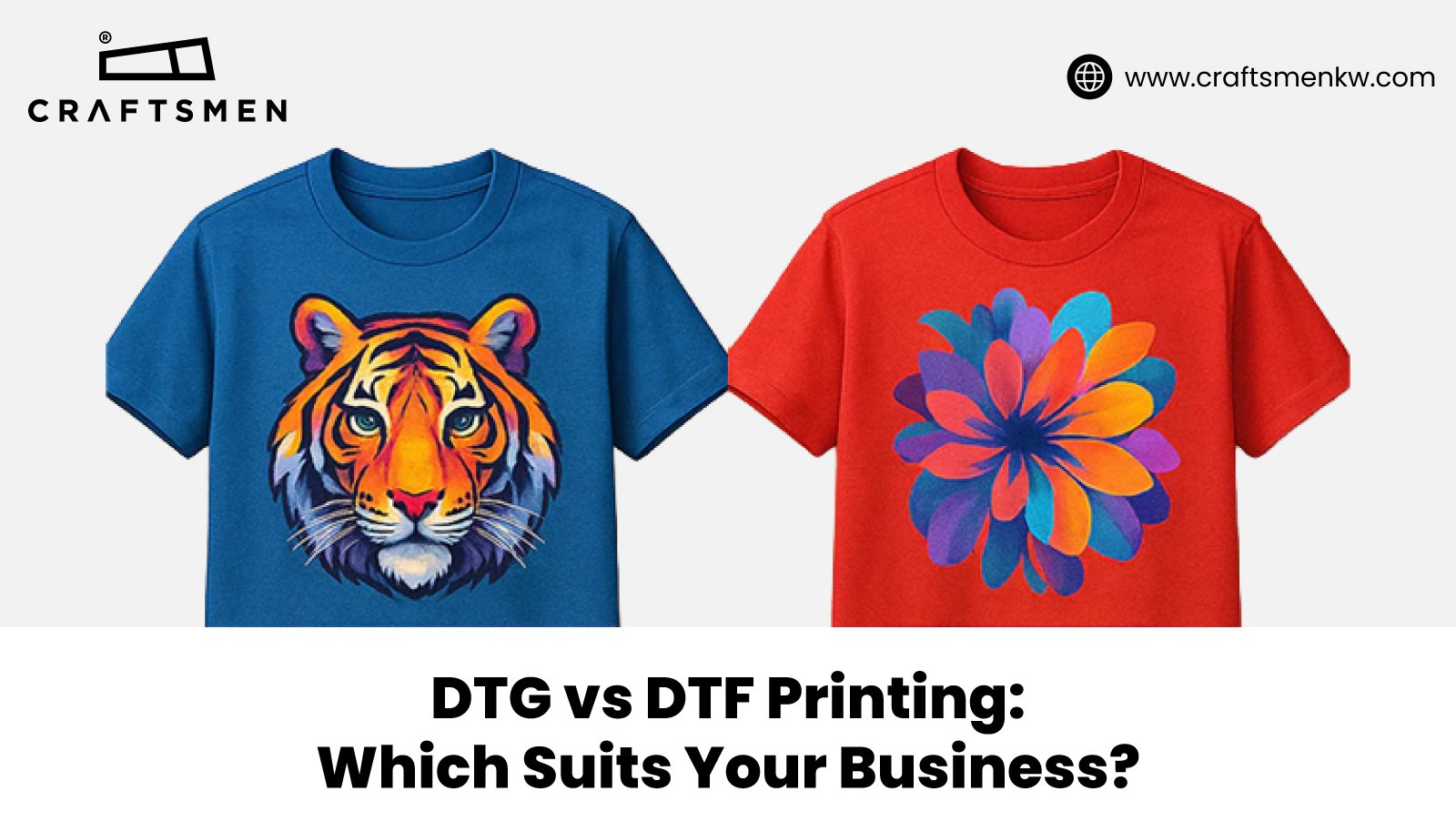
The custom printing industry has changed dramatically over the past decade. What once required expensive screen printing setups, minimum order quantities in the hundreds, and days of preparation can now be done in minutes with digital technology. Two methods — DTG and DTF — have become the dominant choices for businesses, print shops, and brands looking for high-quality, full-colour custom printing.
They look similar on paper. Both produce photographic-quality prints. Both work digitally. Both are suitable for small runs and custom orders. But they are fundamentally different technologies with genuinely different strengths, limitations, and ideal applications.
If you’re choosing between them for your business in Kuwait — whether you’re a print shop, a corporate gifting company, a uniform supplier, or a brand looking to produce custom merchandise — this guide will help you make the right decision.
What Is DTG Printing?
DTG stands for Direct to Garment. The name describes exactly what the technology does: it prints directly onto the surface of a garment using inkjet technology adapted for fabric. A DTG printer works similarly to a desktop inkjet printer, but instead of printing on paper, the platen — the flat bed that holds the material — holds a t-shirt, hoodie, tote bag, or other flat fabric item. Ink is fired directly from the print head onto the fabric and bonds with the fibres.
DTG produces exceptional print quality — it can reproduce photographic images, gradients, and fine detail with accuracy that screen printing cannot match on short runs. There is no colour limitation in a DTG print: every pixel is printed individually, so a full-colour image costs the same to print as a single-colour graphic.
The technology works best on 100% cotton fabrics. Cotton fibres absorb the water-based DTG inks effectively and produce vibrant, wash-durable prints. Blended fabrics — cotton-polyester mixes — produce acceptable results, but as the polyester content increases, colour vibrancy decreases. Pure polyester doesn’t work well with DTG at all.
Dark garments require pre-treatment before DTG printing. A white underbase must be printed first on dark fabric to prevent the coloured inks from being absorbed and lost in the dark background. This adds time and cost to dark garment printing, and the pre-treatment liquid must be cured (usually with a heat press) before the colour print is applied.
What Is DTF Printing?
DTF stands for Direct to Film. The technology is newer than DTG — it became commercially viable around 2020 and has grown rapidly since. Instead of printing directly onto the garment, DTF prints the design onto a special PET film. A hot melt adhesive powder is then applied to the wet ink on the film and cured. The result is a transfer — the printed design on the film, with the adhesive layer underneath it.
This transfer is then applied to the final substrate using a heat press. The heat activates the adhesive, bonding the printed film to the surface. Once cooled, the film is peeled away, leaving the printed design adhered to the substrate.
The critical difference from DTG is that the print happens on film, not on the substrate itself. This means DTF transfers can be applied to virtually any fabric or surface that can withstand heat press temperatures — cotton, polyester, nylon, leather, canvas, denim, and more. There is no pre-treatment required for dark garments. The white ink in the transfer acts as its own base.
DTF also allows for pre-production of transfers — you can print the film in advance and store the transfers, applying them to garments or other substrates only when an order comes in. This gives DTF significant advantages in inventory management and order fulfilment.
Print Quality: How Do They Compare?
Both DTG and DTF produce high-quality, full-colour prints. The differences are subtle but worth understanding.
DTG at its best — on a good quality 100% cotton garment, properly pre-treated — produces prints that feel like part of the fabric. The ink penetrates the fibres rather than sitting on top of them, giving a soft hand feel that many consider more premium than a transfer. Colour reproduction is excellent, and fine detail renders crisply.
DTF produces a print that sits on top of the fabric surface rather than penetrating the fibres. This gives DTF prints a slightly more tactile, slightly glossy finish compared to DTG — noticeable to the touch, though the visual appearance is similar. Some consider this less premium than DTG’s fabric-integrated feel; others prefer the consistency and coverage that a DTF transfer delivers, particularly on dark garments where the print appears bolder.
For photographic images and complex gradients, both perform well. For very fine text and intricate line work, DTG on high-quality cotton has a slight edge. For vibrant, opaque coverage on dark garments, DTF has the advantage — the adhesive transfer method means the white base is printed and cured on film rather than on the garment, giving more consistent results than DTG pre-treatment.
Substrate Compatibility: The Most Important Practical Difference
This is where DTF comprehensively outperforms DTG for most businesses.
DTG is essentially limited to natural fibres — primarily cotton. Printing on anything else produces poor results. This limits DTG to garments: t-shirts, hoodies, tote bags, cotton-based items.
DTF can be applied to:
- Cotton and cotton blends of any ratio
- 100% polyester — perfect for sportswear and activewear
- Nylon — workwear and outerwear
- Denim
- Canvas
- Leather and faux leather
- Some hard surfaces including phone cases, hats, and rigid substrates
For businesses in Kuwait where the product range might include corporate uniforms (often polyester blends), sports kits, bags, caps, and branded merchandise beyond just t-shirts, DTF’s substrate flexibility is a decisive advantage.
Setup Cost and Run Economics
DTG printers are significant capital investments — entry-level commercial DTG machines start at around USD 15,000 to 20,000, and high-volume professional machines cost significantly more. The inks are expensive, particularly the white ink used as underbase for dark garments. White ink also has a tendency to clog print heads if the machine isn’t used regularly, requiring maintenance protocols that add to operational complexity.
DTF printers are generally lower cost to purchase — entry-level DTF setups including printer, powder applicator, and curing equipment can be assembled for less than the equivalent DTG setup. Ink costs are generally lower than DTG white ink in particular. The consumable film is inexpensive.
For print-on-demand single units, DTG’s direct-to-garment workflow is fast — print, cure, done. DTF requires printing the film, applying powder, curing, then heat pressing — which involves more steps but each step is quick.
For production of multiple identical prints, DTF’s ability to pre-print a batch of transfers and press them sequentially is efficient. DTG requires individual garment loading and printing for each item.
Wash Durability
Both methods produce wash-durable prints when correctly executed, but there are nuances.
DTG prints, when properly cured, are wash-durable to 50+ wash cycles before noticeable fading — comparable to screen printing on cotton. The key is proper curing temperature and time. Under-cured DTG prints fade rapidly.
DTF prints are also wash-durable, with manufacturers commonly citing 50+ washes at standard temperatures. The adhesive bond between transfer and substrate can be affected by high-temperature washing or tumble drying at high heat — which can cause the transfer to crack or lift at edges if the application wasn’t perfect. With correct application and normal washing temperatures, DTF prints perform very well.
In Kuwait’s context — where garments may be washed frequently in warm temperatures — both methods are appropriate when correctly applied.
Which Should You Choose?
Choose DTG if:
- Your primary product is 100% cotton t-shirts, hoodies, or tote bags
- You prioritise a soft hand feel that integrates with the fabric
- You primarily print light-coloured garments (avoiding the pre-treatment step on dark items)
- Print-on-demand speed is critical and substrate variety is limited
Choose DTF if:
- You print on a wide range of fabric types — polyester, nylon, blends, denim
- You produce corporate uniforms, sportswear, or workwear (typically polyester-heavy)
- You want consistent results on dark garments without the complexity of pre-treatment
- You want to pre-produce transfers and apply them to order
- You’re producing a variety of branded merchandise beyond garments
For most print businesses in Kuwait that serve the corporate, hospitality, and events market: DTF is the more versatile and commercially practical choice. The ability to print on polyester and blended fabrics opens the full corporate uniform and sportswear market. The pre-treatment requirement on dark garments in DTG is an operational complexity that DTF eliminates. And the substrate flexibility means one technology serves the full range of branded merchandise rather than just cotton garments.
For a dedicated t-shirt printing business focused on premium, fashion-forward cotton products — particularly light-coloured garments — DTG’s soft hand feel and fabric-integrated print quality offers a premium that the market segment will appreciate and that DTF doesn’t fully replicate.
Many serious print operations in Kuwait run both — DTG for premium cotton apparel and DTF for everything else. If the budget allows for one technology to start, DTF’s versatility makes it the higher-value starting point for most business models.
A Note on UV DTF
A third variant — UV DTF — has emerged as a separate technology for hard substrates: phone cases, mugs, pens, keychains, and rigid promotional items. UV DTF uses UV-cured inks rather than heat-activated adhesives and is designed for surfaces that can’t go through a heat press. It’s worth considering alongside conventional DTF if your product range includes hard surface items — common in Kuwait’s corporate gifting and promotional merchandise sector.