

One of the most common questions we receive at Craftsmen Kuwait is also one of the most important: what type of signage do I need? It sounds simple, but the distinction between outdoor and indoor signage covers far more than just where the sign will be mounted. It determines the materials you should use, how the sign is fabricated, how long it will last, how it should be illuminated, and ultimately how much you should expect to invest.
Getting this decision right the first time saves you money, time, and the frustration of replacing a sign that wasn’t built for its environment. This guide breaks down everything you need to know.
Why the Outdoor vs Indoor Distinction Matters More in Kuwait
In many countries, the outdoor vs indoor debate is primarily about aesthetics and visibility. In Kuwait, it carries an additional dimension: environmental resilience.
Kuwait’s climate is among the most demanding on earth for exterior materials. Summer temperatures regularly exceed 50°C in direct sun. UV radiation is intense for the majority of the year. Dust storms — known locally as shamal — are frequent, and the air in coastal areas carries salt that accelerates corrosion. Any sign installed outdoors in Kuwait needs to be specifically engineered to survive these conditions, not just aesthetically designed.
This is why working with a local signage company in Kuwait that understands the environment — rather than ordering generic sign solutions — matters so much.
What Is Outdoor Signage?
Outdoor signage covers any sign, display, or branded element that is installed outside a building or structure, or in a partially exposed environment such as a car park, covered walkway, or open exhibition hall.
Fascia Signs and Building Frontage Signs
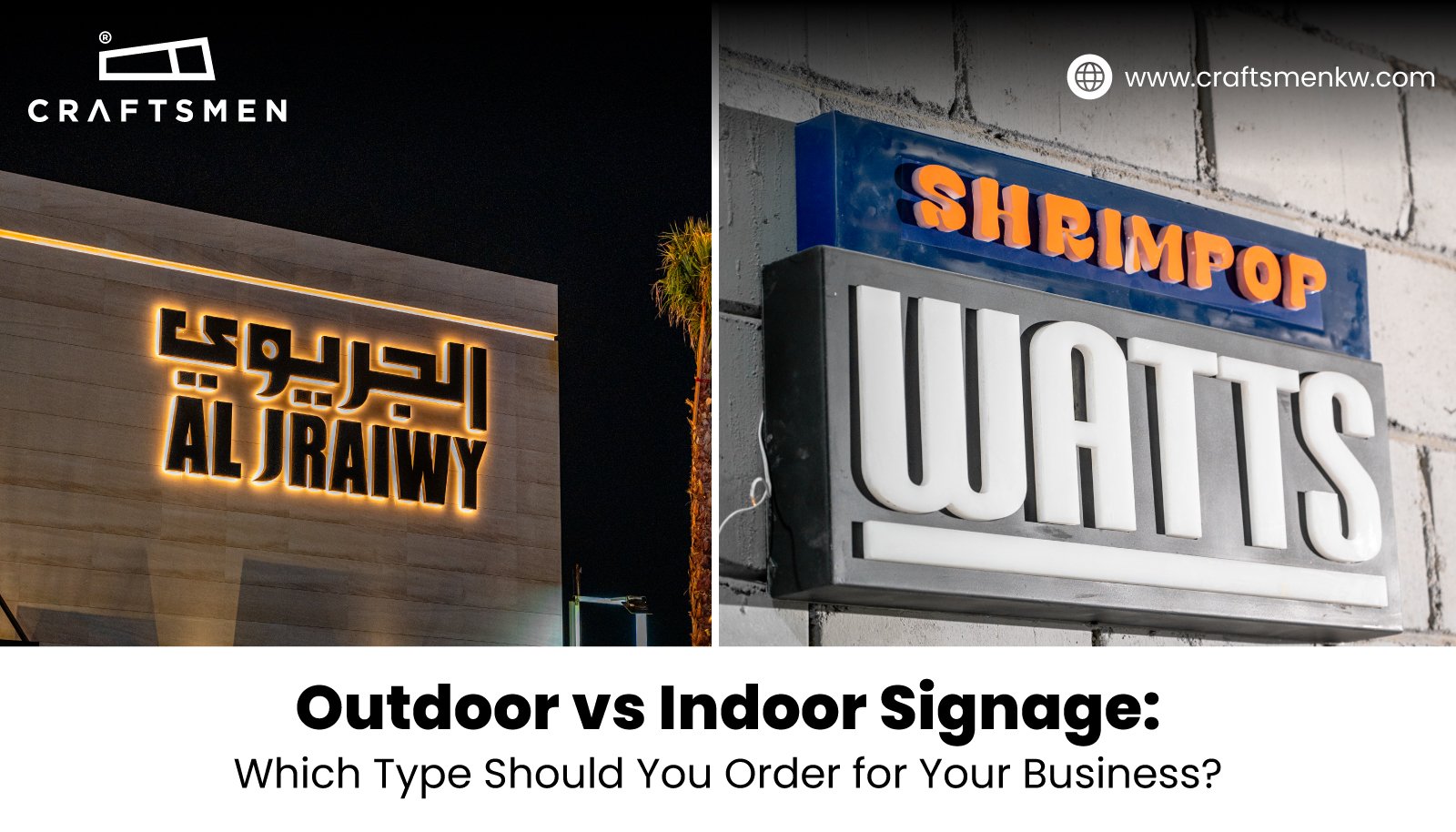
The most fundamental outdoor sign for any business is the building fascia — the sign that identifies your premises from the street. In Kuwait, fascia signs typically feature 3D aluminium or stainless steel letters, LED-illuminated channel letters, or aluminium composite panel cladding with applied lettering. These must be fabricated to withstand direct sun and wind loading.
Pylon and Totem Signs
Tall freestanding signs visible from roads and highways — commonly used by petrol stations, hotels, commercial complexes, and real estate developments. Pylon signs in Kuwait are typically fabricated from steel with aluminium cladding and feature internally illuminated sign faces.
Billboard and Large-Format Banners
Printed banners and billboard applications are common for campaigns, promotions, and event advertising across Kuwait. Outdoor banner material must be UV-stabilised and printed with weather-resistant inks. Structural banner frames for large-scale installations are typically fabricated from steel or aluminium.
Wayfinding and Directional Signs
Car park signs, building directory boards, and directional arrow signs for compounds and commercial developments. These need to be robust, legible at distance, and resistant to weathering.
House Signs and Villa Name Plates
Custom house signs in Kuwait range from simple number plates to elaborate villa entrance signs in brushed stainless steel, laser-cut aluminium, or backlit acrylic. Given the prominence of villa entrances in Kuwaiti residential culture, these are often statement pieces as much as functional identifiers.
Outdoor LED and Neon Signs
LED signage panels, scrolling LED boards, and outdoor neon signs used for retail frontages, restaurant entrances, and entertainment venues. Outdoor LED units must be rated to IP65 or higher for dust and moisture resistance — a critical specification in Kuwait’s environment.
What Is Indoor Signage?
Indoor signage covers any sign installed within a controlled environment — inside a shop, office, mall, hotel, restaurant, hospital, or exhibition hall. While indoor signs don’t need to withstand Kuwait’s outdoor climate, they serve equally important functions: communicating brand identity, guiding customers, and creating an environment that reflects the quality and character of the business.
Reception and Lobby Signs
The first branded touchpoint inside any office or hotel — usually a large wall-mounted logo in 3D letters, backlit acrylic, brushed steel, or a combination. These signs are statement pieces that deserve significant attention to material quality and finish.
Retail Signage
Point-of-sale signs, shelf labels, product display signage, price boards, and promotional posters. Mall-based retail in Kuwait is highly competitive, and the quality of in-store signage directly impacts perception of brand value.
Wayfinding and Directional Indoor Signs
Hospital corridors, hotel floors, office complexes, and shopping malls all require clear internal wayfinding systems — from simple printed directional signs to full environmental graphic systems using cut aluminium, acrylic, and illuminated panels.
Menu Boards and Digital Displays
Food and beverage businesses in Kuwait extensively use illuminated menu boards, digital screens, and printed backlit panels for menu communication. These need to be well-lit, legible, and easy to update.
Neon Signs — Indoor
Decorative LED neon signs for restaurants, cafés, retail spaces, and offices have become one of the most popular interior signage categories in Kuwait. Their warm glow, customisable shapes and colours, and photogenic quality make them social-media favourites. Because they’re indoors, they don’t need weatherproofing — but quality of the LED flex and power supply still matters significantly for longevity.
Office Interior Branding
Wall graphics, vinyl applications, frosted glass manifestations, dimensional lettering on partition walls, and branded signage throughout office interiors. These are increasingly important as companies invest in workspace experience and culture.
Key Differences at a Glance
Outdoor signage requires weatherproof, UV-resistant, and corrosion-resistant materials. LED components must carry a minimum IP65 rating. Suitable substrates include aluminium, steel, ACM/ACP panels, and outdoor-grade acrylic. Fixing must account for structural anchoring and wind load. UV-stable inks and weatherproof vinyl are mandatory. Expected lifespan in Kuwait with correct specification is seven to fifteen years. Municipality permits are typically required.
Indoor signage allows aesthetics-led material choices with lighter substrates. Standard LED is acceptable without high IP ratings. Full acrylic, MDF, PVC, foam board, and standard acrylic are all viable. Standard wall plugs, adhesive mounting, or standoff fixings are appropriate. Standard print materials and non-UV inks are acceptable. Expected lifespan is three to seven years depending on material. Permits are generally not required, though mall tenants must follow mall management approval processes.
Choosing the Right Material for Each Environment
Aluminium and Aluminium Composite (ACP/ACM)
Aluminium is the workhorse of both outdoor and indoor signage in Kuwait. For outdoor use, it provides structural integrity, corrosion resistance, and accepts powder coating that holds colour even under intense UV. Aluminium composite panels are widely used for building cladding, fascia signs, and exhibition structures. For indoor use, aluminium is used for dimensional letters, frames, architectural elements, and display structures, with a wide range of finishes available.
Stainless Steel
Stainless steel is the premium choice for outdoor signage that needs to maintain a pristine appearance over many years — house signs, hotel entrance signs, corporate headquarters fascias. It requires no surface coating, resists Kuwait’s coastal salt air, and carries an inherently premium aesthetic. Indoors, brushed stainless steel dimensional letters are a flagship choice for reception signs and high-end retail.
Acrylic
Standard acrylic is excellent indoors — available in hundreds of colours and finishes, machines and laser-cuts cleanly, and accepts LED illumination beautifully. Outdoors in Kuwait, standard acrylic faces challenges: UV degradation yellows cheaper grades over time, and thermal expansion in extreme heat can cause cracking if not properly designed. UV-stabilised cast acrylic can be used outdoors, but must be specified correctly. At Craftsmen Kuwait, we advise clients on the appropriate acrylic grade for each application.
PVC and Foam Board
Lightweight printed substrates like PVC foam board and foam board are suitable for indoor point-of-sale displays, temporary exhibition graphics, and wall-mounted informational signs. They are not appropriate for outdoor use in Kuwait and will degrade rapidly if exposed.
Vinyl and Sticker Applications
Vinyl graphics and sticker applications are among the most versatile tools in signage. For outdoor use, cast vinyl with UV-resistant laminates performs well on flat surfaces — vehicle graphics, window graphics, wall applications. For indoor use, standard calendered vinyl is sufficient. The key is matching the vinyl specification to the application.
Illumination: Getting It Right for Outdoors vs Indoors
For Outdoor Illuminated Signage
All LED components used outdoors must carry a minimum IP65 rating — dust-tight and water jet resistant. In Kuwait’s dust-heavy environment, we typically specify IP66 or higher for critical applications. LED drivers must be rated for high ambient temperatures, as standard drivers designed for temperate climates will fail rapidly in Kuwait’s outdoor conditions. Wiring and conduit runs must be sealed against dust and moisture ingress, and all connections properly weatherproofed.
For Indoor Illuminated Signage
Indoor LED applications have more flexibility. Standard IP20 LED strips are fine for interior channel letters, lightboxes, and backlit panels. The emphasis indoors shifts to colour rendering (CRI rating), colour temperature, and control systems. For LED neon signs — one of the most popular indoor signage categories in Kuwait — the quality of the LED neon flex, the transformer, and the mounting hardware all significantly impact longevity and appearance. Budget LED neon units from generic suppliers often fail within a year. Properly specified units should last five to seven years or more.
Municipality Approvals for Outdoor Signage in Kuwait
Outdoor signage in Kuwait typically requires approval from the relevant municipal authority before installation. Common requirements include submission of sign design drawings with dimensions, confirmation that the sign meets permitted size limits, structural calculations for large or wind-loaded signs, and electrical compliance certification for illuminated signs. Craftsmen Kuwait assists clients with documentation for municipality submissions and recommends factoring permit timelines into your project schedule.
How to Decide: A Practical Checklist
Before contacting us for a quote, clarify the following: Where exactly will the sign be installed — outside, inside, in a mall, in an open exhibition space? What is the sign’s primary purpose — brand identification, wayfinding, point-of-sale, decorative? What is the viewing distance — a sign read at 50 metres has very different requirements from one read at 1 metre? What is your budget range? What is your installation timeline?
Why Craftsmen Kuwait for Signage
At Craftsmen Kuwait, we design, fabricate, print, and install both indoor and outdoor signage, handling every stage in-house. Our capabilities include 3D letter signs in aluminium, stainless steel, and acrylic; LED signage and lightboxes rated for indoor and outdoor use; neon signs and LED neon flex in custom shapes and colours; aluminium and ACP/ACM fabrication for fascia and building signs; steel fabrication for pylon and structural signage; house signs and villa entrance signs; large-format banner printing and installation; vinyl and sticker printing and application; acrylic fabrication including laser cutting and routing; carpentry and wooden signage elements; and municipality permit documentation assistance.
Contact Craftsmen Kuwait with your project details and we’ll advise on the right type, materials, and specification — then provide a detailed quote covering design, fabrication, and installation.
Craftsmen Kuwait — The Right Sign, Built Right.